Showing posts with label Big Ben. Show all posts

Westminster Bridge


Bronze statue of Boudica, called “Boadicea and Her Daughters” - now a listed building – at the northern end of Westminster Bridge.
The other side features a quote from the 1782 William Cowper’s poem “Boadicea, A Ode”:
REGIONS CAESAR NEVER KNEW
THY POSTERITY SHALL SWAY 
Boudica was the Queen of the Iceni, one of the many Celtic tribes (or Britons) in Ancient Britain, during the Roman conquest (1st century AD).
Thomas Thornycroft  worked of this sculpture from 1856 to 1885.  Prince Albert lent his horses as models, as he and Queen Victoria encouraged the sculptor. However, Prince Albert died before the work was completed. The statue was cast in bronze 17 years after the death of the artist (and the year after the queen’s death) in 1902.
Aside from the fact that the choice of some items are culturally  incorrect (such as a Roman chariot), many ironical points could be raised about this great looking sculpture.
The Queen of the Iceni, who led an uprising against the Romans - after they ignored her husband’s will in order to take all his land, flogged her and raped her two daughters - is here identified by her Latin name first.
In her fight against the invading troops, she, with the help of two other tribes, destroyed Colchester but also this city of London (then known by the Romans as Londinium) - before  poisoning herself, rather than being captured (according to Tacitus). Yet, this defiantly rebellious figure gained centre stage in the Victorian era, the age of the British Empire, and she can now often be used as a representation of a triumphant establishment.
The front of the plinth reads: 
BOADICEA
BOUDICCA
QUEEN OF THE ICENI
WHO DIED A.D. 61
AFTER LEADING HER PEOPLE
AGAINST THE ROMAN INVADER
Here she is on a GB miniature sheet issued for the 150th anniversary of the Penny Black stamp, with Queen Victoria and Queen Elizabeth II, both direct descendants of William I, the Norman Conqueror of Viking ancestry… 
The River Thames at Westminster Bridge. The Ferris Wheel called London Eye is on the south bank – where we pursued our walk. The next bridges are The Golden Jubilee bridges. 
Down below is Westminster Millennium Pier, where tourists can board river boats. Five new piers were opened in 2000. 
The river seemed quite busy with such vessels between Westminster and the Tower of London.
The large white building with ionic columns, across the river, is County Hall (see next post).

The Coats of Arms of Queen Victoria (left) and Albert, Prince Consort (right). There are smaller shields of their coats of arms on the sides of bridge, facing the water.
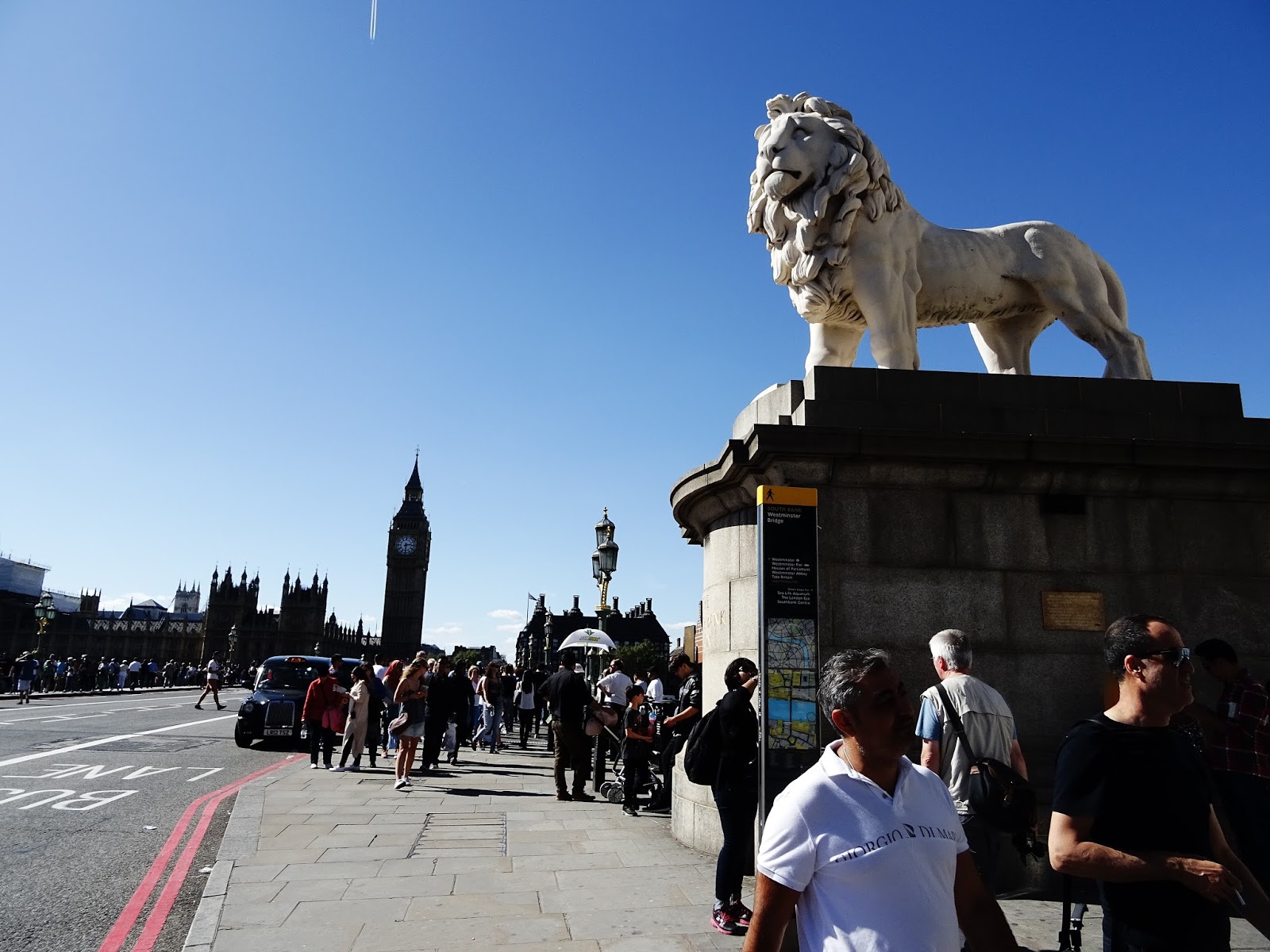
The South Bank Lion weighs 13 tons and is nearly 180 years old. It was one of the 3 lions which stood above the entrance to the Lion Brewery (in Lambeth, London) demolished in 1949 - 
the site is now the Royal Festival Hall, in the South Bank Centre, Europe’s largest centre for the arts, and it is only half a mile downriver). 
The South Bank Lion, the London Eye and County Hall (see next post).
The Lion Brewery was one of the oldest and a pioneer in the field of porter beer production; it was also known as the Red Lion Brewery, therefore this white lion is sometimes called The Red Lion.  What’s more, for a while, it stood at Waterloo Station, where it had been painted red to match with the British Rail logo. The lion has been at Westminster Bridge since 1966. Under one of his paw are the sculptor’s initials and the date 24 May 1837.
Coades artificial stone or Coade stone is a ceramic-based stoneware invented by an Eleanor Coade in 1770. It was then used for moulding statues, which have proved to be weatherproof. It has been used, for instance, at The Royal Pavilion in Brighton, Kew Gardens, Windsor Castle, Buckingham Palace…


If one steps off the footpath, one can take a photo of Westminster Bridge with what seems less tourists on it… Although, I should have checked what double red lines mean… “No Stopping At Any Time”? Oh dear, I stood still and broke the law to take this shot !
Where are the zombies when you need one?
Westminster Bridge was the location of a famous scene in Danny Boyle’s film “28 days Later”
Westminster Bridge under construction from the south-east abutment, 
by Canaletto (1747)
The current Westminster Bridge is a road with footpaths and was opened in 1862. It is the oldest road bridge across the Thames in central London.
Shields with the coats of arms of Queen Victoria and Prince Albert can be spotted here, on the side of the bridge, which is made of wrought iron. The Gothic-style was designed by Charles Barry, the architect behind the current Palace of Westminster. (see post http://gherkinscall.blogspot.co.uk/2016/10/the-palace-of-westminster.html)


Next post: The Queen’s Walk, South Bank - part 1: passing the London Eye, County Hall and Jubilee Gardens
http://gherkinscall.blogspot.co.uk/2016/10/london-eye-county-hall.html


Westminster Abbey

It was Sunday and the Abbey was closed to visitors. Just as well, I hear you say…
This is the view of Westminster Abbey from Parliament Square: 
the North Entrance or the Great North Door.
This rose window, in the north transept, dates from 1722 
(there is a rose window on the south side, from 1814)
I am not sure why the façade is not all the same colour, but the contrast of pale grey and bronze makes it all the more striking. There are three doorways, not all with a door in the middle.
The great door is set in an extremely ornate porch with many carved figures; 
the Virgin Mary holding a crowned baby Jesus is on a column in the middle of the doorway, Salvator Mundi  (Christ the Saviour, holding a globus cruciger) is in a medallion in the tympanum, he is surrounded by angels, below them are the twelve apostles in a row. 
There are many more angels carved in the arch of the porch.


On this north side, there are many more details to look out, if one has time (shields, heads, crosses, etc.) and other statues in niches with canopies; some at the north entrance, but also one at the top of each buttress along the building. There seems to be a mix of saints, church figures, king and queen representation, nobles or knights (don’t quote me on that, I didn’t take close-up pictures…) 


I took pictures of some of the mythical monsters carved in between the three doorways; they seem to support empty pedestals and they were at eye-level (or should I say hat-level?)


The north side is supported by nine buttresses.
The current building has been constructed and added to, over at least 700 years 
and new galleries are due to be added, still.
A few facts about Westminster Abbey:
UNESCO World Heritage Site.
Anglican (Church of England).
British monarchs are traditionally crowned and buried at Westminster Abbey.
It has witnessed several royal weddings, including the current Queen’s wedding - when she was still Princess Elizabeth - and her grandson Prince William’s wedding (2nd in line of succession).
Westminster Abbey has been the place of many funerals, including the funeral of his mother, Diana, Princess of Wales, in 1997.
Actor Lawrence Olivier’s ashes are buried in Poet’s Corner in the Abbey.
Also inside the Abbey is the tomb of the Unknown Warrior, whose body was brought from France and buried in 1920.

Quick History of Westminster Abbey:
There were Benedict monks on this site in the 10th century.
In 1065, Edward the Confessor was buried in the 11th century abbey he had commissioned. Built in the Romanesque style, it was dedicated to St Peter.
In 1066, the Duke of Normandy, William the Conqueror, was crowned here.
Henry II started the abbey’s reconstruction in 1245, with the inclusion a shrine to King Edward the Confessor - the work was finished by 1517!
It got Cathedral status under Henry VIII, in 1540, which spared its destruction when he dissolved all abbeys.
Restored to the Benedictines under Queen Mary I (1553-58).
With Queen Elizabeth I (1558-1603), it became the Collegiate Church of St Peter and a Church of England ‘Royal Peculiar’ – that is under direct jurisdiction of the monarch, rather than a bishop, and headed by a dean.
Oliver Cromwell was buried here in 1658, but disinterred 3 years later to be hanged posthumously! He was then beheaded of his embalmed head…
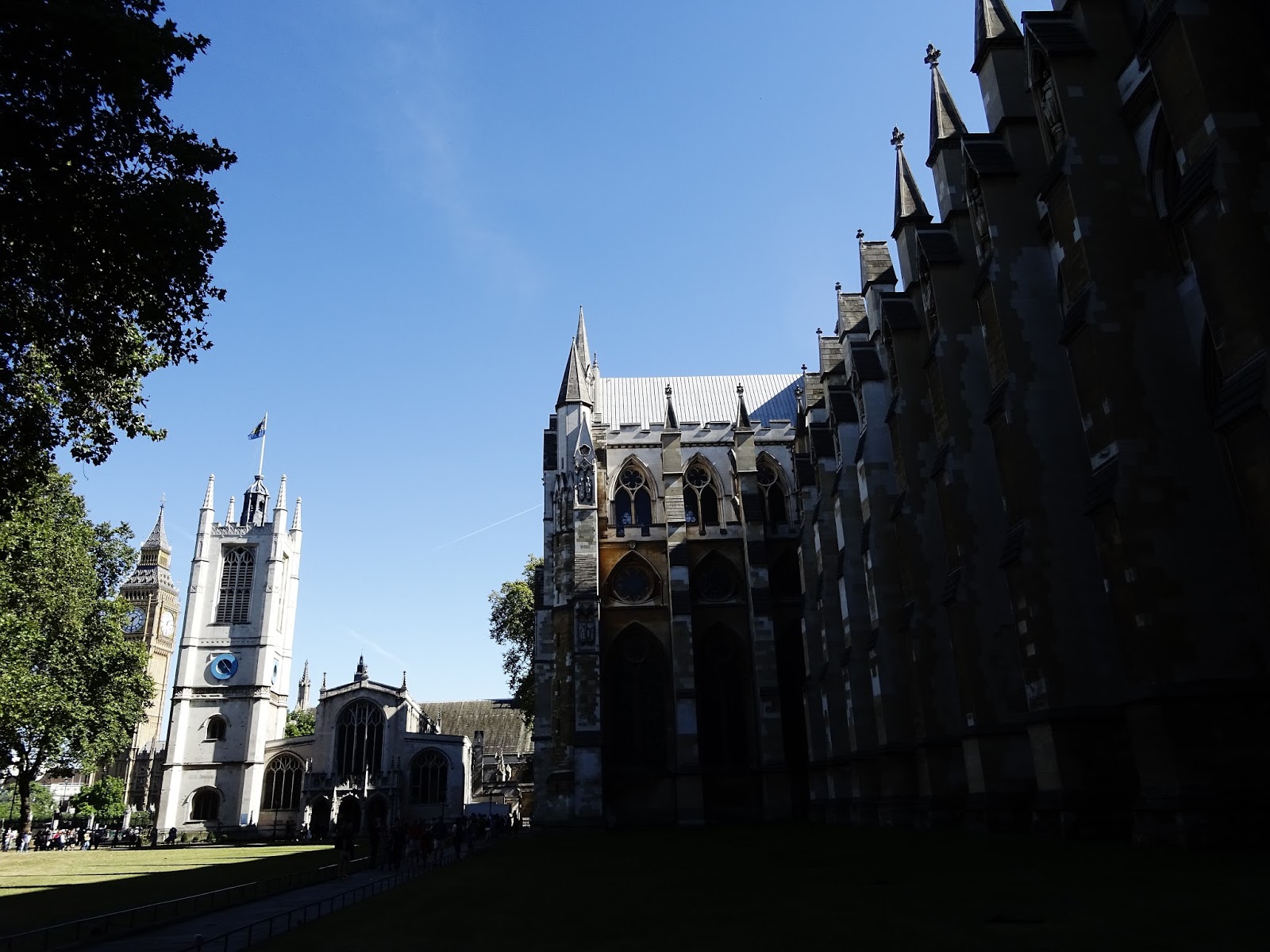
‘Big Ben’ and St Margaret’s Church dwarfed by Westminster Abbey.
By Canaletto in 1749
The main entrance is by the Great West Door.
The two western towers are 18th century (Gothic revival style). Sir Christopher Wren commenced the work on the design but he did not enjoy mixing different styles of architecture.
Fancy street lamp: big church ruining the photo…

Above the great window with pointed panels, is a cornice with a frieze inscribed 
"A. R. GEORGII II. VIII. MDCCXXXV." (1735)
Below the window, is a frieze with colourful coats of arms. 
Since 1998, ten statues of 20th century Christian martyrs sit in niches above the Great West Door 
– the spaces had always been left vacant since the 14th c. when this part of the church was added. 
Martin Luther King is 5th from the left.
At the same time, four statues of virtues, these martyrs lived their lives by, were added below them: (from left to right) Truth, Justice, Mercy and Peace.
The order of the statues has been chosen with “architectural rhythm” in mind.
The 10 Christian martyrs are (from left to right):
Maximilian Kolbe, Poland, died 1943: Roman Catholic saint, Franciscan, killed by the Nazis.
Manche Masmeola, South Africa, died 1928, aged 16: Anglican catechist, killed by her mother.
Janani Luwum, Uganda, died 1977: Anglican archbishop, assassinated during rule of Idi Amin.
Grand Duchess Elizabeth of Russia, died 1918: Orthodox saint, killed by the Bolsheviks.
Martin Luther King, USA, died 1968: Baptist civil-rights leader, assassinated.
Oscar Romero, El Salvador, died 1980: Roman Catholic archbishop, assassinated.
Dietrich Bonhoeffer, Germany, died 1945: Lutheran theologian, killed by the Nazis.
Esther John, Pakistan, died 1960: Presbyterian evangelist, killed by her Muslim brother.
Lucian Tapiedi, New Guinea, died 1942: Anglican, one of 12 killed by Japanese invaders.
Wang Zhiming, China, died 1972: Pastor and evangelist, killed in the Cultural Revolution.
A prayer, on the left handside of the entrance, at the bottom of one of the western towers.
May God grant us good soles, in times of wet floors, especially in outdoor England…
Chunks of stone missing, I don’t know if that is WWII damage. In 1939, many of Westminster Abbey's treasures were evacuated for safety to country estates. The medieval Cosmati pavement and tombs in the centre of the Abbey had been boarded over and were not damaged when fire bombs fell through the roof. Some of the stained glass windows were boarded over too, yet they suffered a lot of damage. 60,000 sandbags were used to protect tombs. The Coronation Chair was sent to Gloucester Cathedral and the Coronation Stone was buried secretly within the Abbey. The collection of wax funeral effigies was stored in Piccadilly tube station. 
The memorial to Innocent Victims of War and Oppression (1998) by Irish sculptor Ken Thompson. The slate disk, set in a large circular stone base, is inscribed with the words, “Remember ALL INNOCENT VICTIMS OF OPPRESSION VIOLENCE WAR” and a quote from the Bible, “Is it nothing to you all you who pass by"
The flag of Westminster Abbey features the coat of arms of Edward The Confessor and above it, the House of Tudor coat of arms, between two Tudor roses.

The little square in front of Westminster Abbey is called The Sanctuary and is not square shaped…
The Abbey used to be a sanctuary, a church in which fugitives could not be arrested, this being recognized by English law until the 17th c.) This lead to this area being populated y many criminals; in fact a nearby street used to be called Thieving Lane.
Adjacent to  the Abbey is a Grade II building known as The Sanctuary, so as not to confuse it with anything else in the area… 
Built in 1854 “by the prominent Victoria Architect, Sir George Gilbert Scott,” it is now a block of office suites and I think may also house part of the Deanery.
It looks in excellent condition and features some nice stone carving. 

The entrance is constructed like a gatehouse; through this passage, one can go to Dean’s Yard, a little garden, part of Westminster Abbey’s precincts, but opened to the public.
It is the tradition that pupils from Westminster School (next door) have the right to play football on the grass – it is said that the game originates from here.
The memorial and the 1986 Queen Elizabeth II Centre
seen through the archway of The Sanctuary building
I was a little intrigued by the pinkish column opposite the west entrance of the Abbey, as I cannot remember ever noticing it on previous visits…
It has been here since 1861… It was designed by Sir George Gilbert Scott to remember former pupils of Westminster School who died in the Crimean War (1854-56) and the Indian Mutiny (1857-58).
The Crimea and Indian Mutiny Memorial (or Westminster Scholars War Memorial) is made of marble, pink Peterhead granite and Portland limestone (base). I think it is 19 metres high approximately.  There is a long dedication on the base and the 19 names of the fallen.
ELIZABETH REGINA
At the very top is a figure of St George slaying the dragon and below that, under the canopies, are the statues of St Edward the Confessor, Henry III, Elizabeth I and Queen Victoria.

VICTORIA REGINA
HENRY III REX
The 4 metres high base is flanked by four lions. 
On the left, ‘Big Ben’ and St Margaret’s Church strangely seem to stand side by side.


The memorial and Central Hall Westminster, the largest conference venue in central London, which also houses offices and an art gallery. It is also known as Methodist Central Hall Westminster, as it was the headquarters of the Methodist Church of Great Britain until 2000. The building was completed in 1908 with donations from Methodists. One of the first examples  in Britain of a reinforced concrete structure. It is still being used as a Methodist church and has a grand organ. Churchill, Gandhi and Martin Luther King have all made speeches here. 
It has been used for public enquiries, including the 10 year long Bloody Sunday Inquiry.
Nice shadow of Westminster Abbey on this screenshot!

Next post: Crossing the Thames at Westminster Bridge, to follow The Queen’s Walk along the Southbank
http://gherkinscall.blogspot.co.uk/2016/10/westminster-bridge.html