
 |
White and stylish, with a fashionably bearded mascaron
(sculpted face): the South-East corner of Government Offices Great George
Street (GOGGS) along Parliament Square, at the corner of Great George’s Street
and Parliament Street. That side dates from 1917 (the other side was completed
in 1908). It is described as being Edwardian Baroque Revival style. It houses
many government offices including the Treasury, Revenue & Customs, UK
Export Finance, the Internal Audit Agency, the Department of Culture, Media &
Sport, the offices of the leaders of the House of Commons and of the House of
Lords, part of the Northern Ireland Office, the Churchill War Rooms (a section
of the Imperial War Museum)…
|
 |
I feel St Margaret’s
Church suffers from bad signage…
As the tourists follow the path from the
sign, they seem to direct their eyes and cameras
towards the North Entrance of
Westminster Abbey
which is right beside the smaller white church
and some
photos of the abbey’s north portal have been wrongly posted online
under
the name St Margaret’s Church…
|
 |
This is St Margaret’s
Church (1523)
Rebuilt on the site of a Benedictine Abbey
Anglican Parish Church of the House of Commons
The tower is 18th c. as well as the stone on
the façade; more features were altered later, including the porch and the
interior
It is known for its stained glass commemorative windows
There is a golden reredos (ornamental screen) at the
altar - dating from 1905, it is closed during Lent - and monuments to women who
served Elizabeth I
Sir Walter Raleigh is buried here – oh Raleigh? (window
and memorial inside the church – he had been beheaded for treason a few yards
away on Old Palace Yard)
Outside, on the east wall (back of the church) is a bust
of Charles I, ironically facing the statue of his nemesis, Oliver Cromwell, outside
Westminster Hall (see post http://gherkinscall.blogspot.co.uk/2016/10/the-palace-of-westminster.html
)
Winston and Clementine got married here in 1908
The church suffered damage during WWII
|
 |
18th century scene, before the Palace of Westminster
was built
(Westminster Hall is the blue roof, behind the row of red houses)
|
 |
I couldn’t identify the flag, but the plane is an Airbus
A380
|
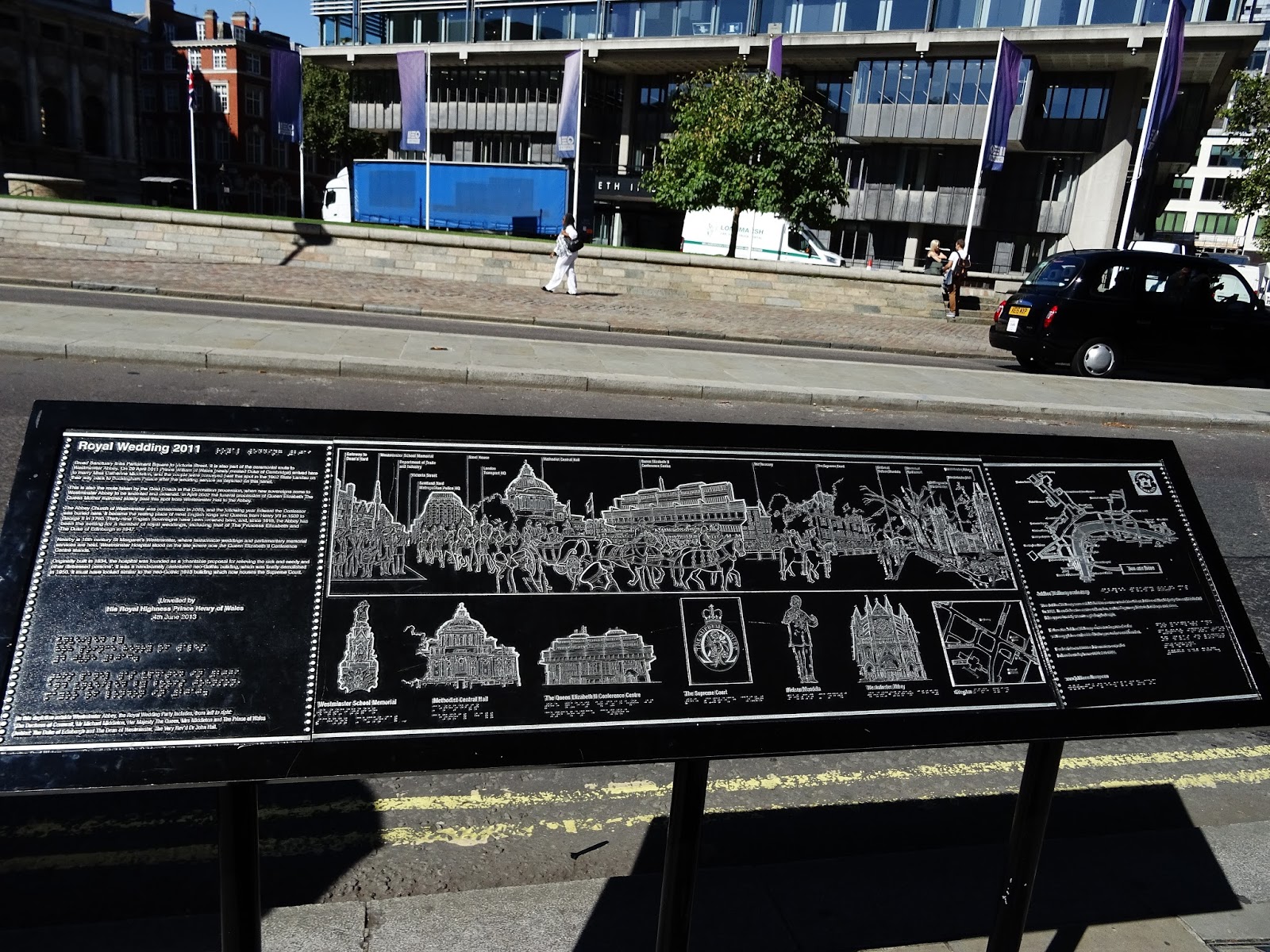 |
On the north side of Westminster Abbey is this commemorative
panel at Broad Sanctuary. It represents a scene from the royal wedding of Prince
William of Wales and Catherine Middleton in 2011. It is useful in naming the
surrounding buildings, such as the modern Queen Elizabeth II Conference Centre
across the road, and beside it, the much more interesting Supreme Court.
|
 |
Just outside the Supreme Court (in the former Middlesex
Guildhall), are two long semi-circular stone benches inscribed with a poem by Andrew
Motion, Poet Laureate when the Supreme Court was established in 2005 (the next post will be my photos of the
Supreme Court)
|
 |
In the back ground, left to right,
Westminster Hall, St
Margaret’s Church, Westminster Abbey (North Entrance)
The Supreme Court poem:
Tides tumbled sand
through seas long-lost to earth;
Sand hardened into-stone – stone cut, then brought To frame the letter of our four nations’ law And square the circle of a single court.
Here Justice sits
and lifts her steady scales
Within the Abbey’s sight and Parliaments But independent of them both. And bound By truth of principle and argument.
A thousand years of
judgment stretch behind –
The weight of rights and freedoms balancing With fairness and with duty to the world: The clarity time-honoured thinking brings.
New structures but
an old foundation stone:
The mind of Justice still at liberty Four nations separate but linked as one: The light of reason falling equally.
Andrew Motion
|
Next post: sculptures on the exterior building of the Supreme
Court / Middlesex Guildhall
http://gherkinscall.blogspot.co.uk/2016/10/the-supreme-court.html
http://gherkinscall.blogspot.co.uk/2016/10/the-supreme-court.html


