Showing posts with label County Hall. Show all posts

London Eye & County Hall

The Queen's Walk is a pedestrian route along the South Bank of the River Thames, between (it says, in some sources) Lambeth Bridge and Tower Bridge. However, we started at Westminster and crossed the river northwards at St Paul to find The Gherkin, before crossing back at London Bridge and The Shard. We went to The Tower the next day.
The Queen’s Walk is a section of the Silver Jubilee Walkway, a 15 mile trail connecting many tourist attractions in London and first opened by Queen Elizabeth II in 1977, for her Silver Jubilee. A part of it was only completed in 1988. From 2002, year of the queen’s Golden Jubilee, the walk was simply promoted as the Jubilee Walkway.  
The Queen’s Walk can be joined from the steps beside the South Bank Lion at Westminster Bridge (see previous post).
Located in the County Hall building: The London Marriott Hotel County Hall 
– there is also a Premier Inn hotel in another part of the building. 
The circular building on the right on the picture is the hotel Park Plaza. 
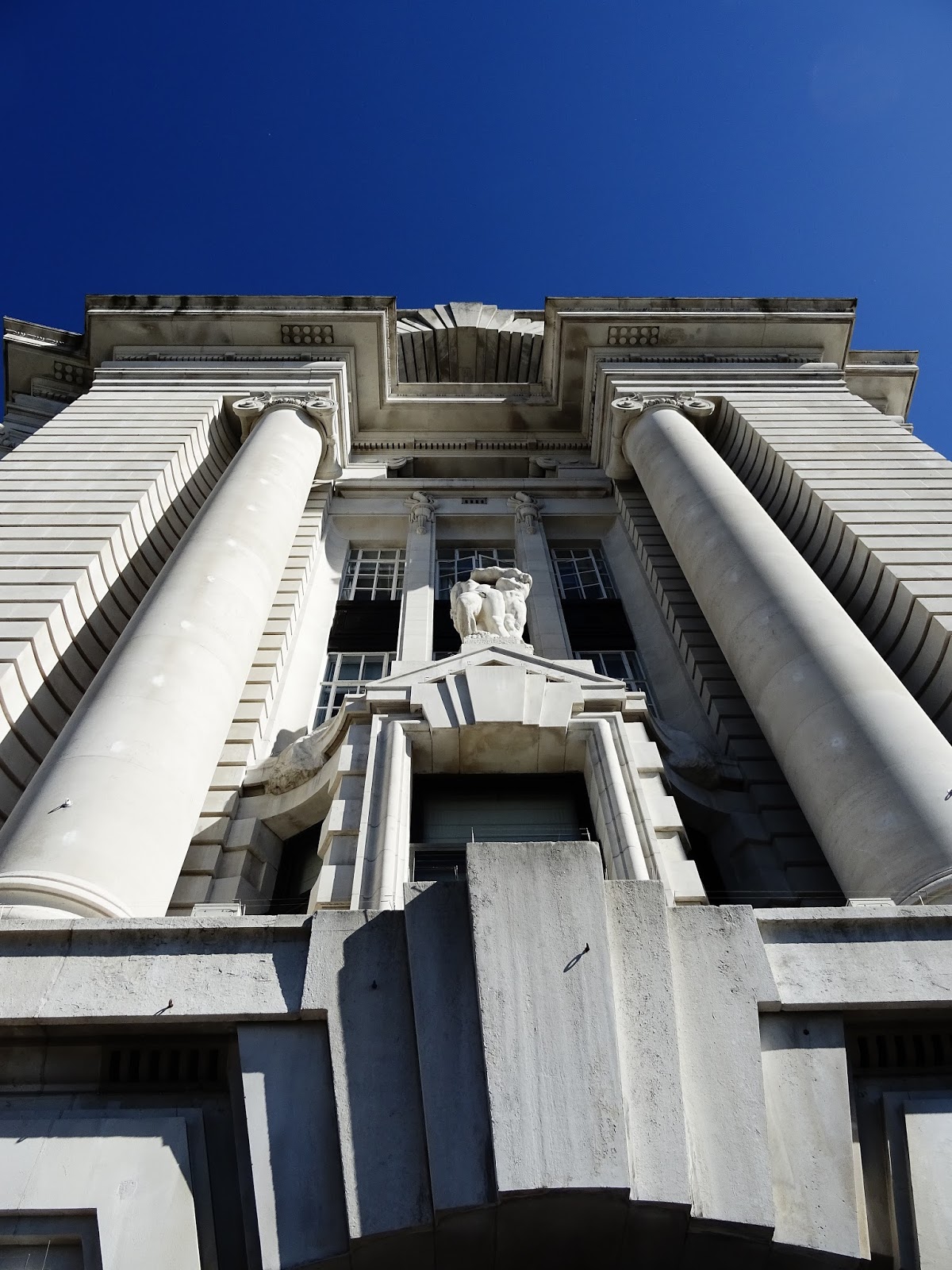
At this corner, is the impressive size of County Hall, with its elegant contrast of great straight lines and curves, large eccentric statues and majestic Ionic columns - very white save for the roof and some verdigris dormer windows and bell tower.
Built in 1922 (with some parts added in the 1930s) and Art Deco in style, it was the headquarters for the Greater London Council (GLC). In the 1980s, the Labour Party held the reins of the GLC, under Ken Livingstone, while, right across the river, the Conservative Party reigned over Parliament when Margaret Thatcher was in government. The façade was famously used as a giant billboard for anti-Tory slogans… In 1986, the GLC was abolished and the building eventually sold. It is now a leisure complex.
1984 GLC - Ken Livingstone


I read that some of the office space is empty, but what a busy place it is! There are cafés and fast food outlets, visitors’ attractions such as amusement arcade, the London Dungeon, the Sea Life Aquarium, DreamWork’s Tours Shrek’s Adventure, etc. and the London Eye Visitor Centre (where one can buy a ticket to use the giant Ferris wheel.)
Ram’s head with tiara ? not a reflection on MacDonald’s food… 
Art Decoy pigeon on top! 
♪♪ Even Billy Joel was promoting the landmarks on The Queen’s Walk that week-end!


Obviously, the London Eye dominates the view here, as its wheel reaches up 135 metres in the air.
When it opened in 1999, it was the tallest observation wheel in the world – not anymore, though its cantilever system makes it still special. 120 metre in diameter, the London Eye remains  the tallest Ferris wheel in Europe, but visiting The Shard’s observation desk offers now an even higher view over London, at 245 metres above the ground! (the skyscraper is further down the riverside.)
Another pier for cruises on the Thames is situated here
– the London Eye Millennium Pier.
The large rounded building at the other end of the railway bridge is Charing Cross railway station (which also houses The Embankment Place shopping complex). 
Beside it, behind the trees is The Royal Horseguards Hotel (with pointed turrets).


The London Eye was supposed to be a temporary feature, it is now the most popular paid-for attraction in the UK, with over 3.5 million visitors a year, more than 40 million passengers so far.
One full rotation lasts 30 minutes and on a clear day, one can view as far as 40 km away.


Next along The Queen’s Walk, following downriver: The Jubilee Gardens with playgrounds, etc. and this bronze sculpture called “Jubilee Oracle” by Alexander (1980)
Charing Cross railway station and Hungerford Railway Bridge across the river.

The quote from the artist reads, 
“Mankind is capable of an awareness that is outside the range of everyday life. My monumental sculptures are created to communicate with that awareness in a way similar to classical music. Just as most symphonies are not intended to be descriptive, so these works do not represent figures or objects.”


Part of the Jubilee Gardens.
The tall office block is called Shell Centre.

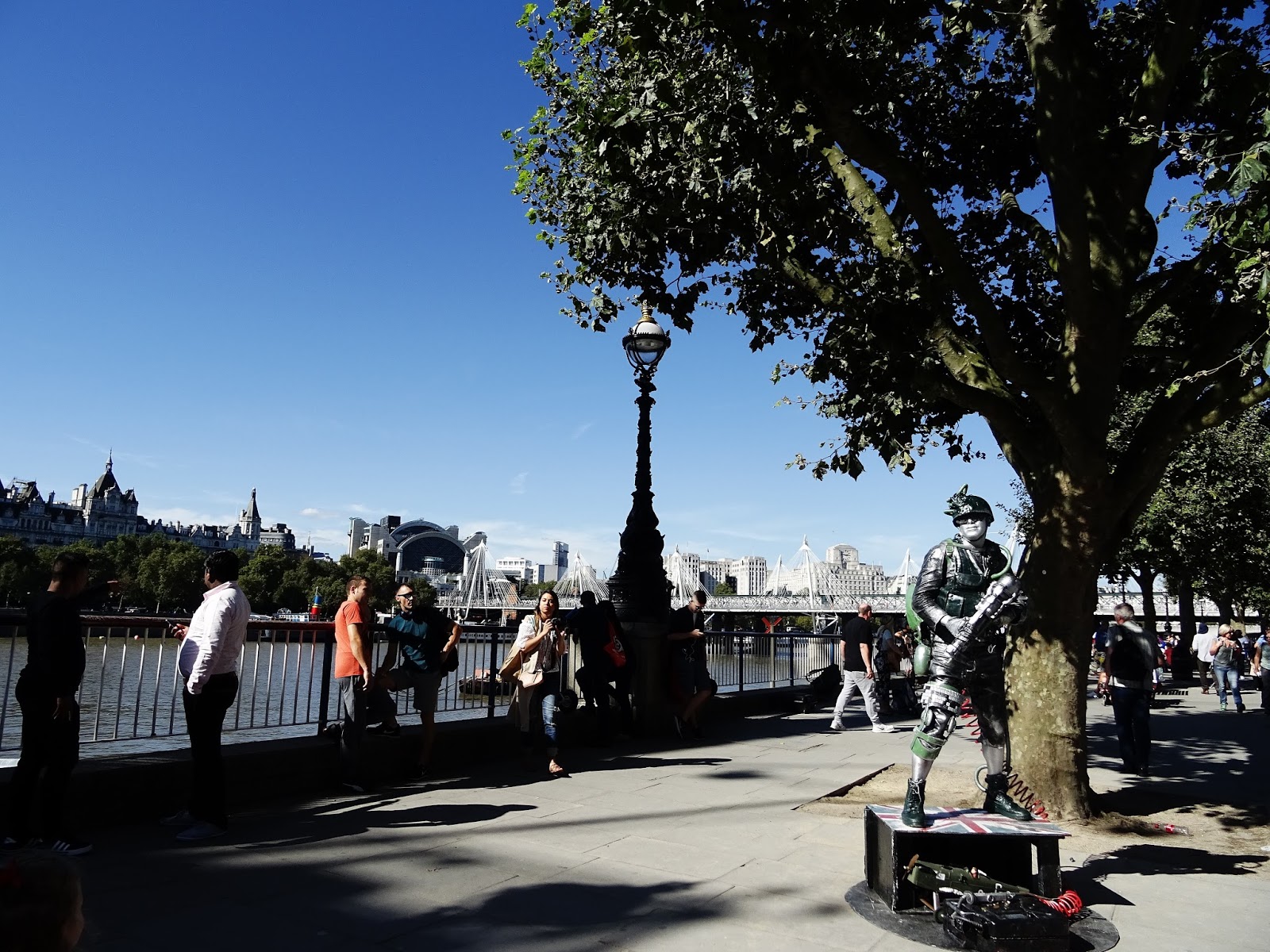
A living statue – the South Bank is buzzing with street entertainers. 
Next post: The Queen’s Walk, South Bank – part 2: Hungerford Railway Bridge and The Queen’s Jubilee Footbridges
http://gherkinscall.blogspot.co.uk/2016/10/hungerford-queens-jubilee-and-waterloo.html


Westminster Bridge


Bronze statue of Boudica, called “Boadicea and Her Daughters” - now a listed building – at the northern end of Westminster Bridge.
The other side features a quote from the 1782 William Cowper’s poem “Boadicea, A Ode”:
REGIONS CAESAR NEVER KNEW
THY POSTERITY SHALL SWAY 
Boudica was the Queen of the Iceni, one of the many Celtic tribes (or Britons) in Ancient Britain, during the Roman conquest (1st century AD).
Thomas Thornycroft  worked of this sculpture from 1856 to 1885.  Prince Albert lent his horses as models, as he and Queen Victoria encouraged the sculptor. However, Prince Albert died before the work was completed. The statue was cast in bronze 17 years after the death of the artist (and the year after the queen’s death) in 1902.
Aside from the fact that the choice of some items are culturally  incorrect (such as a Roman chariot), many ironical points could be raised about this great looking sculpture.
The Queen of the Iceni, who led an uprising against the Romans - after they ignored her husband’s will in order to take all his land, flogged her and raped her two daughters - is here identified by her Latin name first.
In her fight against the invading troops, she, with the help of two other tribes, destroyed Colchester but also this city of London (then known by the Romans as Londinium) - before  poisoning herself, rather than being captured (according to Tacitus). Yet, this defiantly rebellious figure gained centre stage in the Victorian era, the age of the British Empire, and she can now often be used as a representation of a triumphant establishment.
The front of the plinth reads: 
BOADICEA
BOUDICCA
QUEEN OF THE ICENI
WHO DIED A.D. 61
AFTER LEADING HER PEOPLE
AGAINST THE ROMAN INVADER
Here she is on a GB miniature sheet issued for the 150th anniversary of the Penny Black stamp, with Queen Victoria and Queen Elizabeth II, both direct descendants of William I, the Norman Conqueror of Viking ancestry… 
The River Thames at Westminster Bridge. The Ferris Wheel called London Eye is on the south bank – where we pursued our walk. The next bridges are The Golden Jubilee bridges. 
Down below is Westminster Millennium Pier, where tourists can board river boats. Five new piers were opened in 2000. 
The river seemed quite busy with such vessels between Westminster and the Tower of London.
The large white building with ionic columns, across the river, is County Hall (see next post).

The Coats of Arms of Queen Victoria (left) and Albert, Prince Consort (right). There are smaller shields of their coats of arms on the sides of bridge, facing the water.
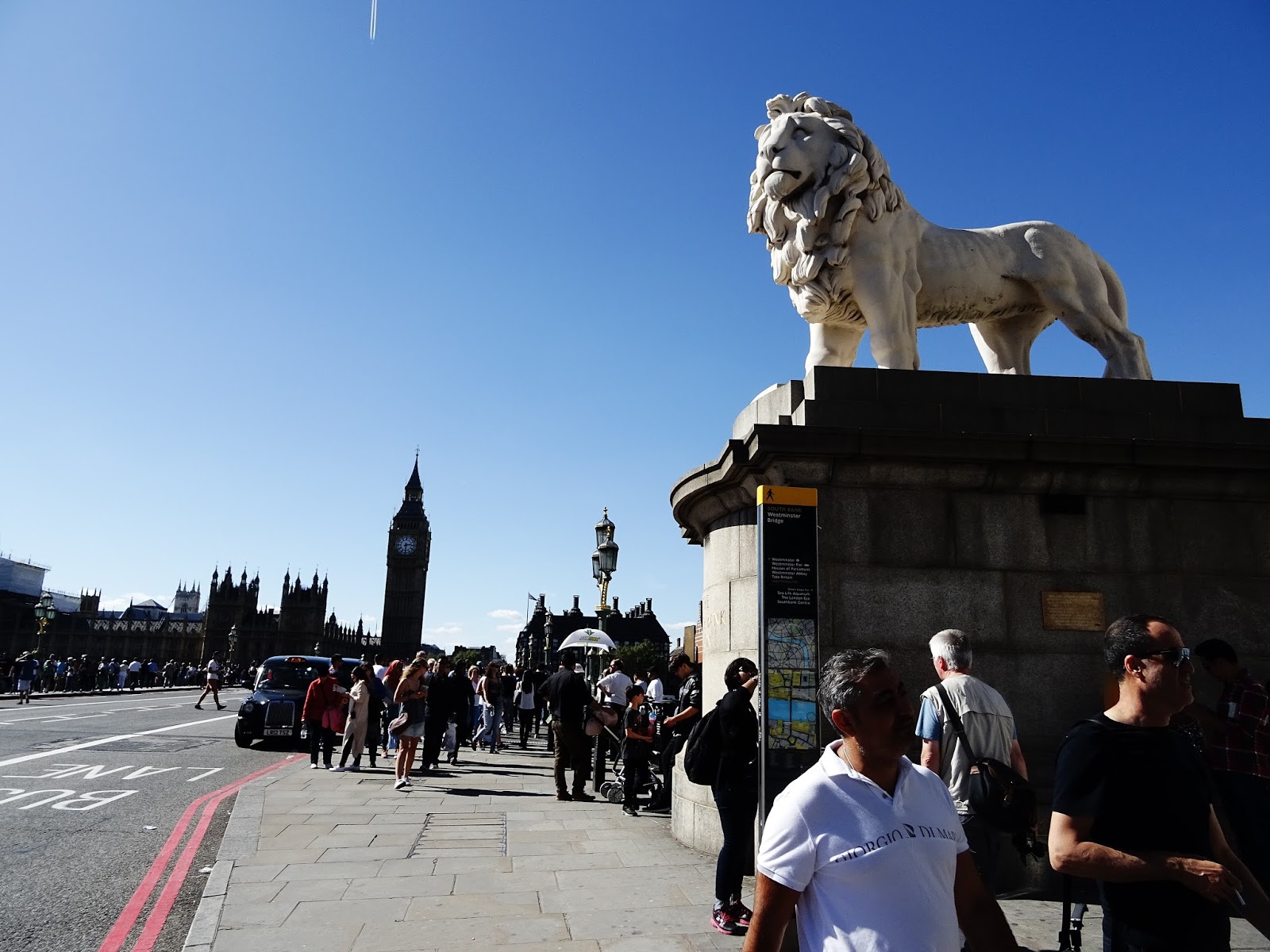
The South Bank Lion weighs 13 tons and is nearly 180 years old. It was one of the 3 lions which stood above the entrance to the Lion Brewery (in Lambeth, London) demolished in 1949 - 
the site is now the Royal Festival Hall, in the South Bank Centre, Europe’s largest centre for the arts, and it is only half a mile downriver). 
The South Bank Lion, the London Eye and County Hall (see next post).
The Lion Brewery was one of the oldest and a pioneer in the field of porter beer production; it was also known as the Red Lion Brewery, therefore this white lion is sometimes called The Red Lion.  What’s more, for a while, it stood at Waterloo Station, where it had been painted red to match with the British Rail logo. The lion has been at Westminster Bridge since 1966. Under one of his paw are the sculptor’s initials and the date 24 May 1837.
Coades artificial stone or Coade stone is a ceramic-based stoneware invented by an Eleanor Coade in 1770. It was then used for moulding statues, which have proved to be weatherproof. It has been used, for instance, at The Royal Pavilion in Brighton, Kew Gardens, Windsor Castle, Buckingham Palace…


If one steps off the footpath, one can take a photo of Westminster Bridge with what seems less tourists on it… Although, I should have checked what double red lines mean… “No Stopping At Any Time”? Oh dear, I stood still and broke the law to take this shot !
Where are the zombies when you need one?
Westminster Bridge was the location of a famous scene in Danny Boyle’s film “28 days Later”
Westminster Bridge under construction from the south-east abutment, 
by Canaletto (1747)
The current Westminster Bridge is a road with footpaths and was opened in 1862. It is the oldest road bridge across the Thames in central London.
Shields with the coats of arms of Queen Victoria and Prince Albert can be spotted here, on the side of the bridge, which is made of wrought iron. The Gothic-style was designed by Charles Barry, the architect behind the current Palace of Westminster. (see post http://gherkinscall.blogspot.co.uk/2016/10/the-palace-of-westminster.html)


Next post: The Queen’s Walk, South Bank - part 1: passing the London Eye, County Hall and Jubilee Gardens
http://gherkinscall.blogspot.co.uk/2016/10/london-eye-county-hall.html