The Supreme Court of the United Kingdom is located in the
building that used to be the Middlesex Guildhall. Its location can be seen as
symbolic, on Parliament Square, a few yards from the Government offices (at GOGGS)
and the legislative assembly at the House of Commons (Palace of Westminster).
The Supreme Court is an independent court of appeal
established in 2005 by the Constitutional Reform Act to separate the judiciary
from the House of Lords in those matters (though it doesn’t apply to Scottish
criminal cases).
The poem, written by Poet Laureate Andrew Motion, to mark
the creation of the Supreme Court is inscribed on benches opposite the main
entrance (see previous post).
Also located here is the Judicial Committee of the Privy
Council which acts as the highest court of appeal for British territories overseas
and some independent Commonwealth nations.
The Middlesex Guildhall was built between 1906 and 1913
with Portland stone, internal steel frame and slate roof. The style is
Neo-Gothic with “Flemish-Burgundian references” (beer and wine?) Great chunks
of bare walls and high amounts of carved ornamental stonework.
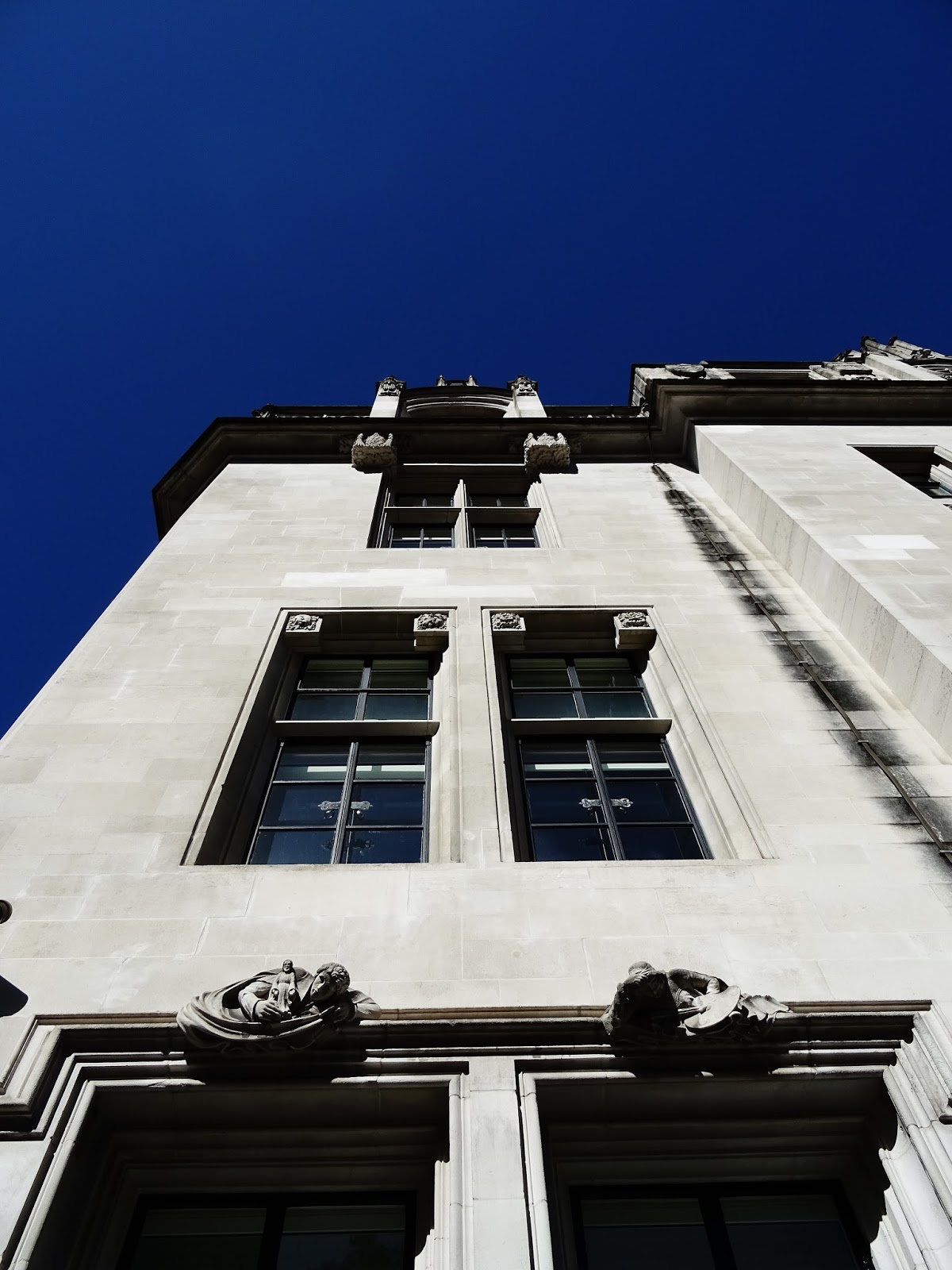
On Broad Sanctuary side, at the first floor, is a long rounded
balcony with fine details, including coats of arms, birds, floral motifs and as
corbels, six winged and crowned angels.
 |
| One is Justice with her scales, one holds an orb and a sceptre, symbols of authority and the monarchy… |
 |
| This one is reading recipes, she is going to cook, what an angel… |
 |
| This one is folding clothes… |
 |
| One is making herself pretty, one is ready to fight. |
There are other carved details on this side of the building, especially at the windows. Windows and stone carvings vary greatly from the dormer windows at the attic level, to the windows on the ground floor.
The Royal Coat of Arms of the United Kingdom is
impressively rendered.

I walked around three sides of the building and took
photographs of all the ground floor windows that have a keystone. Each one is a
different figure, some seem indolent and some lean over to peep down cheekily.
There seems to be a confusing mix of references; some ancient deities and muses
of the arts, some respected craftsmen, as well as Christian and medieval characters…
 |
| a Christian sculptor? |
 |
| a painter |
 |
| harvesting? |
 |
| a pastoral artist? is she smiling? (Thalia?) |
 |
| Aries / Mars, God of war? |
 |
| a pot holder? |
 |
| Poseidon / Neptune |
 |
| is she holding a rotten fish or some flowers? |
 |
| a curious veiled lady (Polyhymnia ?) |
 |
| he seems to be holding pinecones, symbol of enlightenment |
 |
| horn of plenty |
 |
| don’t touch my grapes (Bacchus?) |
 |
| St Agnes with her lamb? |
 |
| is he holding a paddle? |
 |
| a cup or a light? |
 |
| an armourer |
 |
| muse of history with a scroll? |
 |
| a monk |
There must have been some at the back, where I couldn’t
go… I have uploaded 5 pics I found online
 |
| youth and athleticism? |
 |
| is that an astronomer with a sextant? |
 |
| an architect or engineer |
 |
| a master mason |
The entrance to the Supreme Court is a through an impressive
portico with a massive arched balcony and window above, and framed by canted
bay turrets.
Here is Nelson Mandela explaining…
A tall relief frieze extends all the way around the
entrance and the two adjoining towers. The carved stone represents historical
scenes and the amount of detail and vividness is extremely impressive (see
further down).
The portico itself culminates with a row of statues under individual canopies. They have been interpreted as Britannia in the centre, surrounded by muses: architecture, literature, government, sculpture, music, truth, law, seafaring, wisdom and education – the last two must be under the arch, at the balcony window, behind the wire mesh (close-up below).
Yet, looming above all that is also a square tower with
more arches, turret-like corners and a parapet at the top, itself surmounted by
a decorative lantern-style structure that makes the building as high at St
Margaret’s Church. In this chamber is a figure representing the government - a
feminine head at the top of this pic ^
Around the tower is also a frieze with sculpted mythical
beasts, unicorns, lions, coats of arms, roses and thistles. Eight medieval-style
gargoyles are protruding, representing angels of the winds and angels of
protection - 2 of them can be seen in the pic ^
Nice details above the portal, I like the four shields
and the four headgears.
>
I particularly like the knight’s close helmet in the very
centre of the frieze.
I am not sure if the carving under the shield represents
the interior of the Court.
The yellow sticky notes read something like, “I feel guilty all the time” and “it’s going to be ok…”
>
This is King John handing the “Great Charter of The
Liberties - Magna Carta” to the barons at Runnymede in 1215. At his side are three
Christian representatives, including a monk. Behind the king are some spears
but also the 3 lions passant guardant - showing their tongue (arms of England).
The barons are wearing their the knights regalia (flags, chainmail,
helmets, shields and swords) and they are accompanied by their pages and a
monk; behind them are many long spears.
^ This is King John’s son, Henry III, in the 13th century, granting
a charter to Westminster Abbey. The Church is represented by various figures, each
with his own set of items: some hold a staff with a cross, one a crozier, another has some tassels, some wear a mitre, one has a wide brim hat, one man is clearly a monk.
There are some fleur-de-lis on the drapes behind them, the heraldic emblem of
the House of Plantagenet. Henry liked
this part of London: he had his favourite home, the Palace of Westminster,
extended and Westminster Abbey rebuilt – he was crowned there (his second
coronation) and he is buried there too, as per his wishes.

< This is the Duke of Northumberland offering the crown of
England to his daughter-in-law, Lady Jane Grey, known as The Nine-Day Queen (10
July 1553 – 19 July 1553). Both of them, as well as Jane’s husband, Lord Dudley
(at her side in the carved frieze), would be convicted of treason and beheaded (the young couple was aged 17 and 19 respectively). Lady Jane
then became viewed as a Protestant martyr.
In the distance, the North Entrance and the rose window
at Westminster Abbey >
<
Also, on each side of the entrance, is a fine statue
looking down – this one is armed…
The other one is more peaceful-looking and holds a key
and a temple (on left of the frieze over the porch)
All the stone carving on the building is by British
sculptor Henry C. Fehr (1867-1940), his name is engraved below the frieze above
the entrance.
 |
^ Not to be confused with this other entrance on Little Sanctuary...
At the back of the building, on Little Sanctuary, a 17th century entrance has been incorporated in the architecture. This old “Stone Gateway” is all that remains of Tothill Fields Bridewell, a prison that stood on the site now occupied by the (Roman Catholic) Westminster Cathedral – not to be confused with Westminster Abbey…
|