Showing posts with label HMS Belfast. Show all posts

Tower Bridge


Tower Bridge was opened in 1894. It is now a listed building.
Designed by Sir Horace Jones and completed posthumously.
432 workers were involved in its construction which took 8 years.
Sir Horace Jones also (re)designed Leadenhall Market, in Bishopsgate, Old Billingsgate fish market and Smithfield meat market.

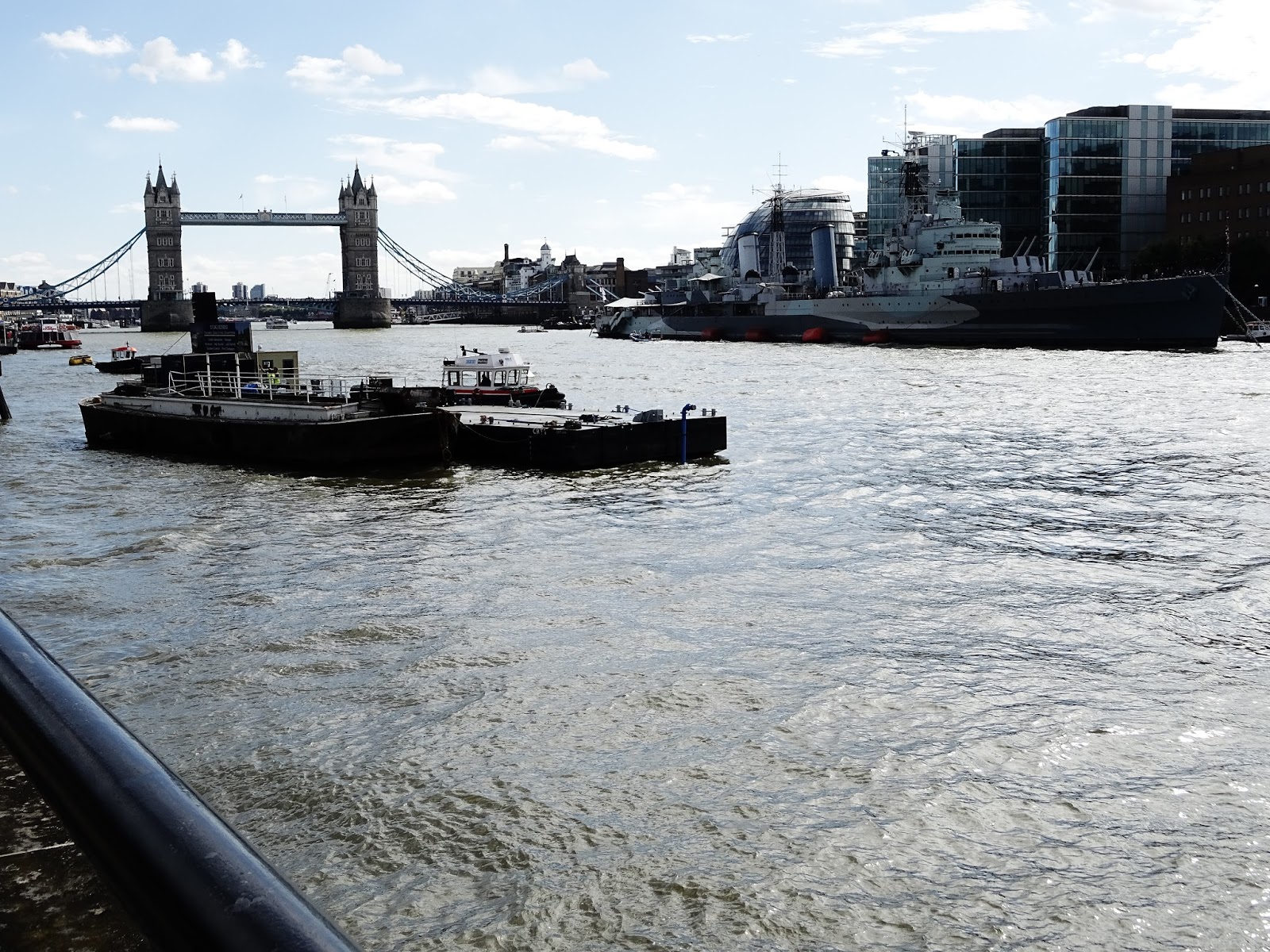
Tower Bridge, City Hall, The Shard, HMS Belfast,
Tower Wharf and The Tower of London (on right)

Tower Bridge is a combined suspension & bascule bridge.
It features two bridge towers built on enormous piers. Between them, the 61 metre-long central span can be raised at an 86° angle, to let large ships pass - thanks to two bascules (drawbridge-type of opening.)
Originally, the raising involved the use of steam engines and hydraulic mechanism.
The system was updated in 1974 with new electro-hydraulic motor using oil.
Nowadays, it only takes 5  minutes to raise the bascules – which happens approximately 1,000 times a year. Only if the size of a ship does require it, or if the Monarch is on board, will the bascules be opened to their widest angle. 


On each side of the bridge towers are the suspension sections, each an extra 82 metre-long span. The ‘chains’ are anchored at the abutments on each shore (straight anchor girders); they pass through the low abutment arch/tower (one at each end of the bridge); vertical rods are holding the chains to the girders; the suspension chains run through the upper walkways, where they are connecting and tied. 

The height of the bridge towers is 65 metres.
They have a steel structure and are clad in Cornish granite and Portland stone.
The bridge towers are also linked by two horizontal upper walkways at about 44 metres above the river.
The upper walkways used to be open to the sky. They were closed in 1910 and remained so, for many years, due to criminal activities taking place where few visitors would go (there was no lift yet in the towers).
Incredibly, on at least two occasions, a plane was illegally flown under the upper walkways. 
The steel bridge towers and upper walkways
under construction in the 19th century
The Tower Bridge Exhibition entrance is on west side of the north bridge tower.
A Tower Bridge Exhibition ticket includes the visit of the bridge towers, the now-covered walkways at the top (including a glass-floored section) and at the southern approach to the bridge, a Victorian engine room, with original steam and hydraulic engines on display, as well as signalling equipment.


“Unattended Bicycles:
Bicycles are not to be secured to the fencing.
Bicycle racks are provided at each end of the Wharf.”


The view from Tower Wharf, right against the northern abutment of Tower Bridge:
rounded City Hall and pointy Shard.
HMS Belfast passing under Tower Bridge (the bridge's bascules fully raised).

Tower Bridge was officially opened by The Prince of Wales, future king Edward VII, and his wife Alexandra of Denmark.
In 1886, a large stone plaque was added to the abutment on the Tower Wharf side. It features a finely detailed carved-coat of arms, and two sculpted turrets. It reads: “THIS MEMORIAL STONE was laid by HRH ALBERT EDWARD, PRINCE of WALES KG on BEHALF of HER MAJESTY QUEEN VICTORIA, Monday June 21st 1886, in the 50th Year of HER MAJESTY'S long happy and prosperous reign”

At each end of the bridge, there is an Abutment Arch or Tower, with matching architectural style.
To exit The Tower of London area and get to Tower Bridge Approach, one has to walk under the abutment and under the road that goes though the arch. 
Great door. Good coffee especially if you have a coupon for a free cup!

Looking upriver from under Tower Bridge, towards London Bridge.
HMS Belfast permanently moored on the southern shore of The Thames (centre of pic.)


The colour scheme for the metal parts of the bridge is currently blue and white. Repainted between 2008-2012. Before that, I think that, it had been red-white-bleu since the Queen’s Silver Jubilee in 1977.

Huge anchoring point for the suspension chain, nicely painted.

Emerging from under the road, looking up at the North Abutment Tower/Arch. 
In blue and white, the steel anchoring girder, part of the suspension system.


There are steps to get back to road level with several nice City of London coat of arms.
The London Borough of Tower Hamlets, where I believe we were in fact
standing, was only granted a coat of arms in 1965.

The view of The Tower of London, from the northern end of Tower Bridge.
Post with our photos of The Tower of London
http://gherkinscall.blogspot.co.uk/2017/02/the-tower-of-london.html

To the north of the bridge, the road is known as Tower Bridge Approach.
Tower Bridge carries a very busy road, the A 100, with footpaths alongside barrier fences.
40,000 users each day!
The road passes through the bridge towers, whereas the pedestrians walk around them.
The bridge is exactly half a mile long, including the approaches.
North Abutment Arch of Tower Bridge and The Shard.

Until 1991, when the large Queen Elizabeth II Bridge opened downstream, Tower Bridge was the first bridge across The Thames one would come to, when travelling up The Thames Estuary.
Photos of the estuary and The Thames from the plane


Old Billingsgate Walk

A few buildings sighted while walking along the northern shore of the River Thames, between London Bridge and Tower Bridge.


This stretch of the river used to known as The Pool of London: imported cargoes had to stop here to be inspected by Customs Officers, at “Legal Quays.” Customs House is still here (now HMRC, tax office), next door to Old Billingsgate.
Old Billingsate at No.1 Old Billingsgate Walk is an 1875 building, now an events venue but it was originally Billingsgate Fish Market, the world's largest fish market in the 19th century). It was a fish market until 1982.
The design is by Sir Howard Jones, the architect behind Tower Bridge
(see post http://gherkinscall.blogspot.co.uk/2017/02/tower-bridge.html).
George Orwell worked here for a while (read his memoir “Down and Out in Paris and London,” published in 1933.)
No.1 Old Billingsgate features several fish-sculptures, on the roof and even on top of the weather vane. The view of the rest of the building was blocked by some event being set up.
There are three main spaces for hire inside: gallery, grand hall (triple height and sky-lit) and the vault. The plant rooms and the roof tops can also be used as film location.


There is even a little fish on top of the street lamp nearby. 
Tower Bridge & HMS Belfast moored across the river.
As described in the previous post, HMS Belfast (1938 navy cruiser) is now 
a museum ship and a popular tourist attraction 
City Hall (spherical building, see further down) & HMS Belfast.
HMS Belfast and No.1 London Bridge (see http://gherkinscall.blogspot.co.uk/2017/01/london-bridge-shard.htmlas seen from The Tower of London,
City Hall (on left), The Shard, and HMS Belfast, as seen from The Tower of London.
The round glass building is City Hall (2002, designed by Norman Foster).
City Hall is the headquarters for the Greater London Authority, i.e. the London Assembly and the Mayor of London (not to be confused with the Lord Mayor of London who leads the City of London Corporation and resides at Mansion House
The area surrounding City Hall has been renamed More London Riverside.
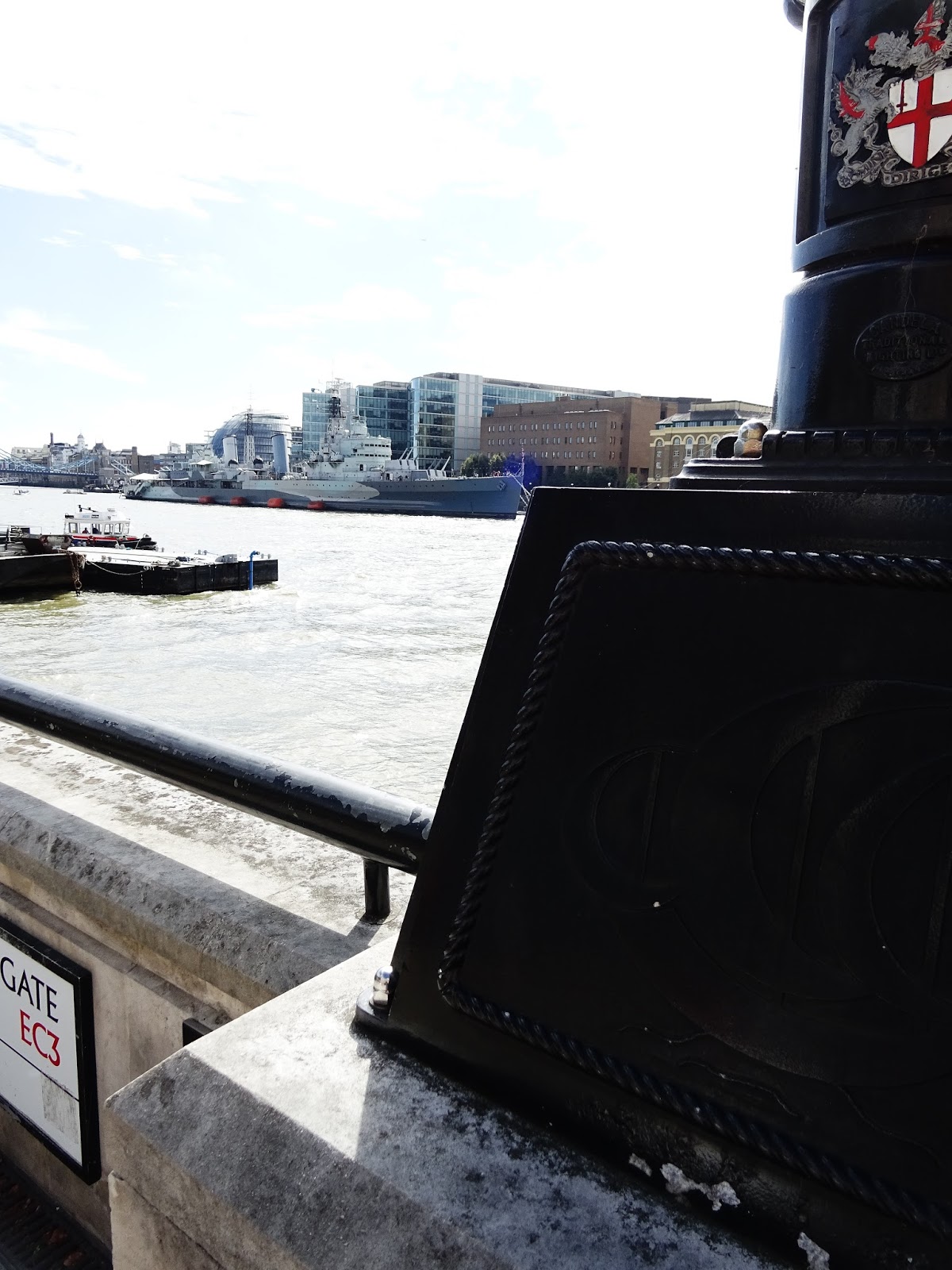
HMS Belfast - and ship emblem on the street lamp?

The Shard with the sun in our faces; fish / dolphin figure on the street lamp and the City of London coat of arms with its motto, in Latin “Domine Dirige Nos” (“Lord, guide us”). 

From left to right in the pic:
Hay’s Galleria, with an arched glass roof in the middle is a listed structure, named after the merchant Alexander Hay.
Originally a brewhouse in the 17th c, converted into a wharf and enclosed dock with warehouse, in the 19th c. and renamed Hay’s Wharf. It was an important place for the arrival of tea.
It was rebuilt after a fire on Southwark in 1861. Shackelton’s ship was docked here in 1921 before he left for his last expedition. The place was bombed during WWII. It closed in 1970 but was redeveloped in the 1980s as offices and shops. The glass roof was added then, making Hay’s Galleria a pleasant shopping mall. One office block is called Shackelton House.
The Shard and below, in front of the London Bridge City Pier, another building with a glass roof in the middle (this one angled.) Next door to that is the London Bridge Hospital (private hospital built in 1986) which has expanded into the next building, St Olaf House, the first Art Deco building in the UK. This building, on the right of the pic, bears the name Hay’s Wharf on its riverside façade (although it is too dark to see in this pic). St Olave’s Church had been demolished in the 1920s to build this office block as the headquarters of the Hay’s Wharf Company.
Gulls and cormorant eyeing the view of Hay’s Galleria, The Shard, London Bridge City Pier, London Bridge Hospital, St Olaf House, No.1 London Bridge, London Bridge.
GULL
"I love this post."
CORMORANT
"This is all a bit of a blur to me…"

The walk along the riverside ended here, at Customs House and 
we took a turn onto Lower Thames Street to get us to The Tower of London.
(HMS Belfast is well camouflaged.)


I was a bit surprised to see a young woman camping here…
The Shard reflecting on The Thames (seen from The Tower of London)