Showing posts with label Palace of Westminster. Show all posts

Westminster Bridge


Bronze statue of Boudica, called “Boadicea and Her Daughters” - now a listed building – at the northern end of Westminster Bridge.
The other side features a quote from the 1782 William Cowper’s poem “Boadicea, A Ode”:
REGIONS CAESAR NEVER KNEW
THY POSTERITY SHALL SWAY 
Boudica was the Queen of the Iceni, one of the many Celtic tribes (or Britons) in Ancient Britain, during the Roman conquest (1st century AD).
Thomas Thornycroft  worked of this sculpture from 1856 to 1885.  Prince Albert lent his horses as models, as he and Queen Victoria encouraged the sculptor. However, Prince Albert died before the work was completed. The statue was cast in bronze 17 years after the death of the artist (and the year after the queen’s death) in 1902.
Aside from the fact that the choice of some items are culturally  incorrect (such as a Roman chariot), many ironical points could be raised about this great looking sculpture.
The Queen of the Iceni, who led an uprising against the Romans - after they ignored her husband’s will in order to take all his land, flogged her and raped her two daughters - is here identified by her Latin name first.
In her fight against the invading troops, she, with the help of two other tribes, destroyed Colchester but also this city of London (then known by the Romans as Londinium) - before  poisoning herself, rather than being captured (according to Tacitus). Yet, this defiantly rebellious figure gained centre stage in the Victorian era, the age of the British Empire, and she can now often be used as a representation of a triumphant establishment.
The front of the plinth reads: 
BOADICEA
BOUDICCA
QUEEN OF THE ICENI
WHO DIED A.D. 61
AFTER LEADING HER PEOPLE
AGAINST THE ROMAN INVADER
Here she is on a GB miniature sheet issued for the 150th anniversary of the Penny Black stamp, with Queen Victoria and Queen Elizabeth II, both direct descendants of William I, the Norman Conqueror of Viking ancestry… 
The River Thames at Westminster Bridge. The Ferris Wheel called London Eye is on the south bank – where we pursued our walk. The next bridges are The Golden Jubilee bridges. 
Down below is Westminster Millennium Pier, where tourists can board river boats. Five new piers were opened in 2000. 
The river seemed quite busy with such vessels between Westminster and the Tower of London.
The large white building with ionic columns, across the river, is County Hall (see next post).

The Coats of Arms of Queen Victoria (left) and Albert, Prince Consort (right). There are smaller shields of their coats of arms on the sides of bridge, facing the water.
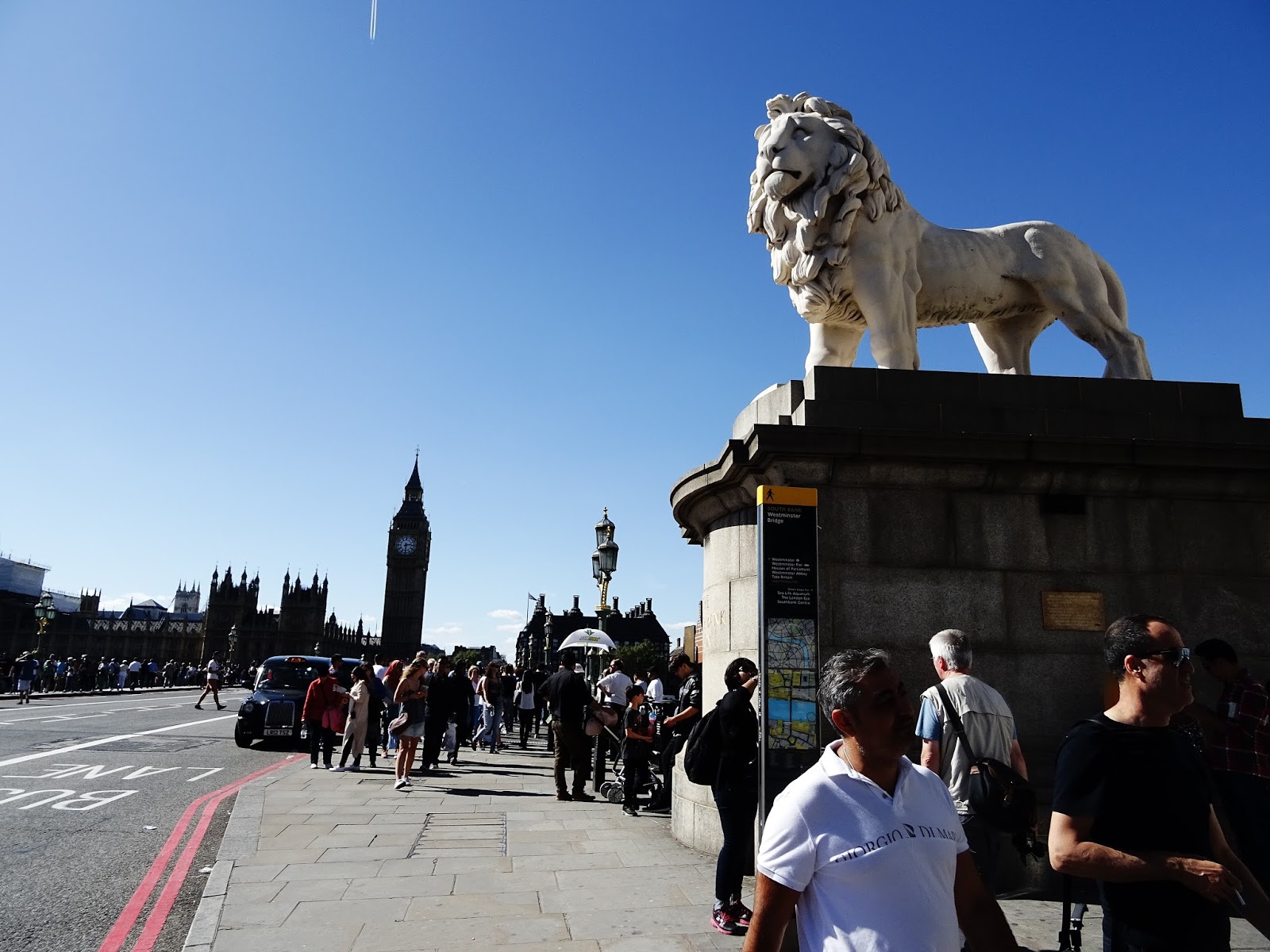
The South Bank Lion weighs 13 tons and is nearly 180 years old. It was one of the 3 lions which stood above the entrance to the Lion Brewery (in Lambeth, London) demolished in 1949 - 
the site is now the Royal Festival Hall, in the South Bank Centre, Europe’s largest centre for the arts, and it is only half a mile downriver). 
The South Bank Lion, the London Eye and County Hall (see next post).
The Lion Brewery was one of the oldest and a pioneer in the field of porter beer production; it was also known as the Red Lion Brewery, therefore this white lion is sometimes called The Red Lion.  What’s more, for a while, it stood at Waterloo Station, where it had been painted red to match with the British Rail logo. The lion has been at Westminster Bridge since 1966. Under one of his paw are the sculptor’s initials and the date 24 May 1837.
Coades artificial stone or Coade stone is a ceramic-based stoneware invented by an Eleanor Coade in 1770. It was then used for moulding statues, which have proved to be weatherproof. It has been used, for instance, at The Royal Pavilion in Brighton, Kew Gardens, Windsor Castle, Buckingham Palace…


If one steps off the footpath, one can take a photo of Westminster Bridge with what seems less tourists on it… Although, I should have checked what double red lines mean… “No Stopping At Any Time”? Oh dear, I stood still and broke the law to take this shot !
Where are the zombies when you need one?
Westminster Bridge was the location of a famous scene in Danny Boyle’s film “28 days Later”
Westminster Bridge under construction from the south-east abutment, 
by Canaletto (1747)
The current Westminster Bridge is a road with footpaths and was opened in 1862. It is the oldest road bridge across the Thames in central London.
Shields with the coats of arms of Queen Victoria and Prince Albert can be spotted here, on the side of the bridge, which is made of wrought iron. The Gothic-style was designed by Charles Barry, the architect behind the current Palace of Westminster. (see post http://gherkinscall.blogspot.co.uk/2016/10/the-palace-of-westminster.html)


Next post: The Queen’s Walk, South Bank - part 1: passing the London Eye, County Hall and Jubilee Gardens
http://gherkinscall.blogspot.co.uk/2016/10/london-eye-county-hall.html


Parliament Square Garden

 Some of the eleven bronze statues on Parliament Square...
Winston Churchill
British Prime Minister 1940–1945 + 1951–1955
(statue unveiled 1973)
The white building is the Government Offices Great George Street (GOGGS) 
which houses many governmental departments including 
the Treasury and Revenue & Customs
Churchill facing the famous ‘Big Ben’ (the Palace of Westminster)
David Lloyd George
British Prime Minister 1916–1922
(statue unveiled 2007 by the Prince of Wales, 
the plinth is slate from Wales, Lloyd George was Welsh)
Jan Christian Smuts
South African Prime Minister 1919–1924 + 1939–1948
(statue unveiled 1956, on a pedestal of South African granite)
GOGGS building behind
Henry John Temple, Viscount Palmerston
British Prime Minister 1855–1858 + 1859–1865
(statue unveiled 1876)
Edward Stanley, Earl of Derby
British Prime Minister 1852 + 1858–1859 + 1866–1868
(statue unveiled 1874, detailed bronze reliefs on pedestal,
the one at the front depicts him addressing the House of Commons on the subject of the abolition of slavery)
His last premiership was followed by Benjamin Disraeli’s who was British Prime Minister 1868 + 1874–1880 and whose 1883 statue is nearby on the square (not pictured here)
On the right of the picture is the statue of George Canning
British Prime Minister 1827
(statue unveiled 1832)
The red brick building is The Royal Institution of Chartered Surveyors
Robert Peel
British Prime Minister 1834–1835 + 1841–1846
(statue unveiled 1877)
Founder of the modern police service, his name has led to the use of the slang word “a peeler” for a police officer; 
meanwhile the lettering on the pedestal has largely peeled off - is no one policing this place?
The sculpture-ridden building behind is Middlesex Guildhall, home of the Supreme Court 
(see post http://gherkinscall.blogspot.co.uk/2016/10/the-supreme-court.html)
Indian Independence Leader
(statue unveiled 2015)
Behind Gandhi, the statue of President Lincoln (see further down)
Bapu facing the Palace of Westminster. 
Though it is in the shade, Gandhi's statue is the object of many photographs
South African President 1994–1999
(statue unveiled 2007)
Madiba’s statue seemed to be a bit of a magnet for people just waiting or resting or even having their lunch on the plinth.
It stands at a busy corner of the square, looking towards St Margaret’s Church


Abraham Lincoln
American President 1861–1865
(statue unveiled 1920, it is a replica of the statue “Abraham Lincoln: The Man” / “Standing Lincoln” in Chicago)
The pedestal is very high and features 32 stars


Lincoln standing across the road from the GOGGS building
click on the name to read about the career of each illustrious leader

Next post: more photos from Parliament Square, including St Margaret's Church
http://gherkinscall.blogspot.co.uk/2016/10/parliament-square.html

The Palace of Westminster


The view emerging from the London Underground
Westminster Station, under Portcullis House.

Bridge Street:
Portcullis House (2001 - Parliamentary Estate and Tube station) on the left;
on the right: The Palace of Westminster (the Houses of Parliament)
with Elizabeth Tower (known as Big Ben, one of the five bells it houses).
Parliament Square:
The Shard (2 miles away and the tallest building in the UK) can be seen here
between Portcullis House and Big Ben.

Far right in the pic: the octagonal Central Tower (91 metres) is in fact a ventilation shaft.
In front of it: the largest clear-span medieval roof in England, Westminster Hall (1097) - the oldest part of the Palace, it survived two fires (in the 16th & 19th centuries) and World War II bombing (roof is 21 metres x 73 metres approx. made of oak,
at least 600 oak trees were used, some 900 years ago).
The 'new' palace is mostly 19th century, gothic in style and took 30 years to build. The architect was Charles Barry; his Commons Chamber could not be saved from the fire that followed one of the several bombings of the Palace during WWII. 

New Palace Yard dates from the original medieval Palace of Westminster (1097), it is now a garden
above an underground car park, but is not opened to the public.
New Palace Yard and Westminster Hall
(on the right: less ornate than the rest of the palace, with battlements on its turrets.)
Along Westminster Hall is Cromwell Green (lower than Abingdon Street)
and its statue of Oliver Cromwell.
The Union Jack flies over Victoria Tower (98.5 metres) which is the site of the Sovereign's Entrance and the Parliamentary Archives. Past the railing, on Old Palace Yard, stands the 19th century statue of Richard I Coeur de Lion - King Richard The Lionheart, riding his horse and holding a sword (which got bent by a bomb during the WWII Blitz, the statue has since been repaired).
Guy Fawkes and his confederates were hanged in that yard and Sir Walter Raleigh was beheaded there too (the latter was buried at St Margaret's Church, a few yards away, on Parliament Square).
Oliver Cromwell - Lord Protector 
of the Commonwealth of England, Scotland and Ireland (1653-1658). 
Half a century after the erection of Cromwell’s statue, a bust of Charles I was donated and placed outside the east wall of St Margaret’s Church (in the 1950s), thus facing Cromwell who had signed the death warrant that lead to the King being beheaded in 1649.
An Airbus A380 flying over with its 4 engines.


New Palace Yard
Obligatory discussion about the trees ensued...
There are 6 Indian Bean Trees on this site and they are believed to be at least 150 years old.
Originally from North America, Catalpas are recognisable by their long bean-like pods and their contorted trunks.
The 1859 Clock Tower was renamed Elizabeth Tower in 2012
to celebrate Queen Elizabeth II's Diamond Jubilee.
It is 96 metres high, it leans and oscillates slightly.
The top part is covered in cast iron plates.

The clock is the second largest four-faced chiming clock in the world and
it is due to be silent and covered for a three-year-long repair work.
The dials are 7 metres in diameter and behind opal glass.
The hour hands weigh 300 kg each.
The bell called Big Ben is over 2 metres in height, its hammer weighs 200 kg.

From Bridge Street: Speaker's Tower (left in pic) is at the north end of the Palace,
it also faces the river front and Westminster Bridge.

The Ferris wheel, London Eye, is across the River Thames, on the south bank.


The Palace of Westminster with St Margaret's Church (paler building)
and Westminster Abbey (far right) are a UNESCO World Heritage Site

Next post: the statues on Parliament Square
http://gherkinscall.blogspot.co.uk/2016/10/parliament-square-garden.html